
Foundational Signal Report | September 2026
The Owner’s Guide to Construction Intelligence
A detailed owner-focused framework for turning fragmented market, project, financial, execution and asset information into decision-ready intelligence.
Vantage Signal
Original research, project analysis and conversations about how construction projects and markets perform, and the signals shaping what happens next.
Vantage Signal is an evidence-led publication about how construction projects and markets perform—and the signals shaping what happens next.
Signal Reports
Foundational Signal Report | September 2026
A detailed owner-focused framework for turning fragmented market, project, financial, execution and asset information into decision-ready intelligence.
Signal Data
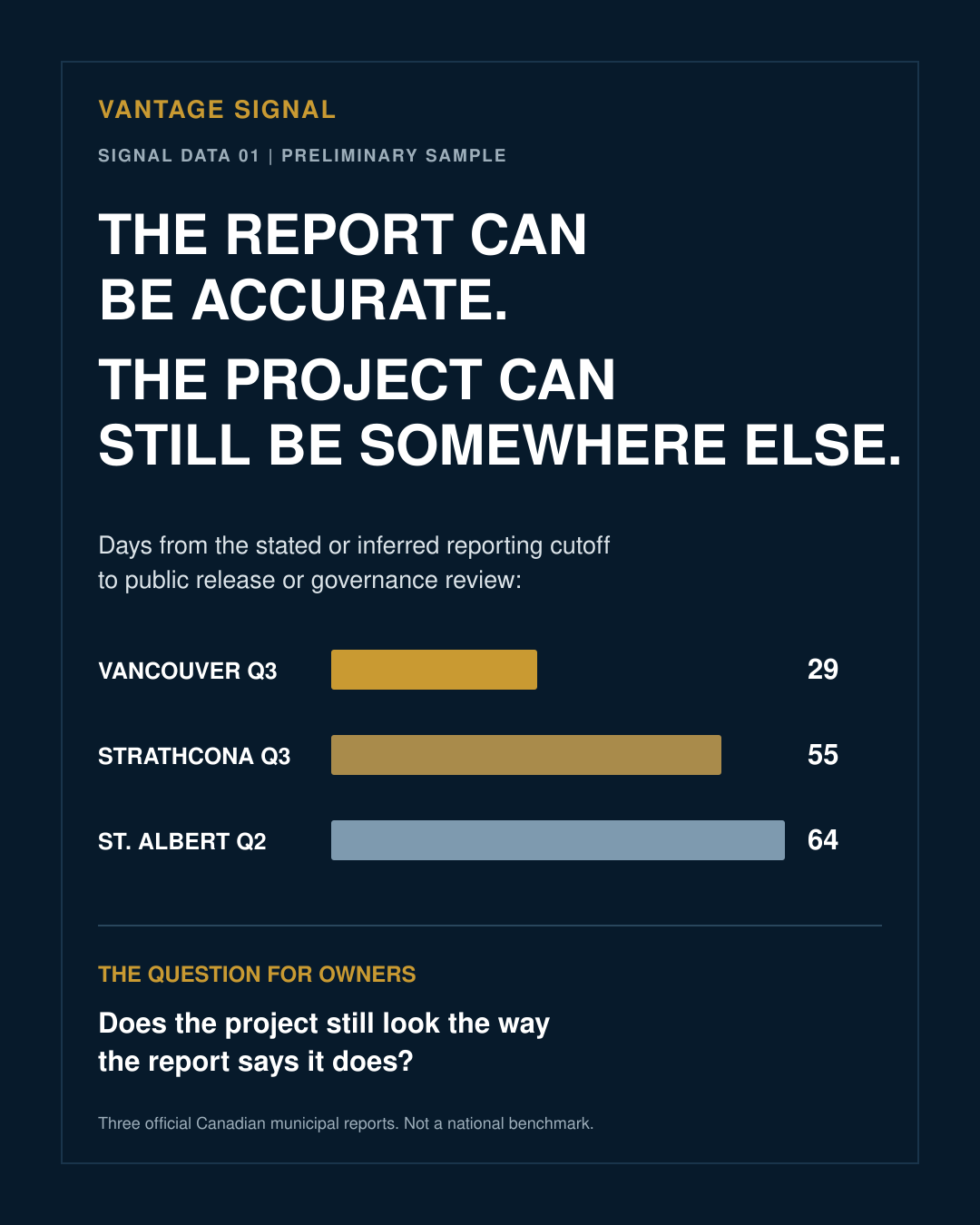
Signal Data 01 | Research in Progress
Research in ProgressA preliminary examination of information currency in Canadian public capital-project oversight.
3 initial reports | Alberta and British Columbia | Research expanding
Explore the preliminary findingsIntelligence Methodology
Intelligence Methodology 01 | September 2026
A practical standard for connecting evidence, testing interpretations and directing proportionate owner action.
Project Anatomy
Project Anatomy 01 | September 2026
A hypothetical recreation-facility scenario showing how fragmented records may reveal a narrowing owner decision window.
Signal Briefing
Signal Briefing 01 | September 2026
How float consumption, unresolved constraints, compressed testing and assumed recovery can weaken a project while its headline completion date remains intact.
Lead story
More from Signal
Construction projects produce thousands of records. The missing layer is not more information, but the ability to connect distributed signals into an evidence-backed view of execution pressure.
A change order can be administratively complete while remaining operationally incomplete. By the time it reaches the owner for approval, the commercial exposure has already formed — in a history of decisions, access constraints, and unresolved dependencies the submission may not reveal.
Construction owners receive hundreds of data points every week. Yet when a project begins to slip, the owner is often the last to see the full picture. The warning signs were present — but not connected. This is the structural problem conventional reporting cannot fix.
Finishing phases absorb blame for project overruns they rarely cause. The real failure happens earlier — during rough-in, inspection windows, and the structural phases that quietly consume float before finishing ever begins.
Construction delays aren't random events — they follow structural patterns rooted in schedule topology, dependency density, and resource concentration. Understanding the physics of how delays form reveals why traditional mitigation strategies address symptoms instead of causes.
Most inspection-related delays do not come from failed approvals. They come from approvals compressing into the same narrow window, increasing coupling, reducing flexibility, and turning small shifts into system-wide disruption.
Applied intelligence
Vantage connects project information to identify emerging execution pressure and produce evidence-backed findings for owners and stakeholders.